Choosing Photos You Will Not Be There to Explain
A photograph you will not be there to explain has to work without you, and that rules out most of what people instinctively choose. Scenery needs a witness. Milestones are already documented by everyone else who was there. In-jokes die with the person who made them. What survives unnarrated is faces, rooms and ordinary days, with you in the frame rather than behind the camera. The test is to say out loud the sentence you would tell them about each photo: if the meaning lives in the sentence and not in the picture, leave it out. A Viallo capsule delivers on a date you pick and opens with no account, and replies are off by default, so plan for a one way delivery that has to stand on its own.
The Photograph Has to Do the Whole Job
Almost every photograph you have ever shown someone, you showed them in person. You handed over the phone and started talking. That's where the year was, that's who that is, that's the house before we painted it. The picture was a prompt and you were the recording.
A capsule opened years from now removes the recording. Whether you are simply elsewhere on the day, or no longer around at all, the effect on the photographs is identical: they arrive unaccompanied to someone who cannot ask a follow up question. Replies are off by default, which is the right shape for a keepsake and the wrong shape for anything that needs clarifying.
So the editing problem is not "which photos are good". It is which photos still mean something after the voice that used to come with them is gone. Those are different sets, and the second one is much smaller.
Say the Sentence Out Loud, Then Take It Away
There is one test and it takes about four seconds per photo. Look at the picture and say aloud the thing you would tell them if you were sitting next to them. Then ask whether anything of that sentence is visible in the frame.
"That's your grandmother in the blue coat she wore for eleven years" passes, because the woman and the coat are both there. "That's the beach where we decided to move" fails, because the decision is not in the photograph and neither are you. The second photo is not a bad photo. It is a bookmark for a story, and bookmarks do not travel.
Run the whole selection through this once and you will typically lose between a third and a half of it. That loss is the point. What is left is the material that can survive without a narrator, which is the only material a capsule can actually deliver.
Faces Beat Scenery, With One Exception
Landscapes are the most photographed and least survivable category there is. A view means something because you were standing in it, and none of that standing is in the file. Twenty years later a beautiful empty coastline is indistinguishable from a stock image, and it will be scrolled past in under a second by someone who was not there.
Faces do not have this problem. A face is legible to a stranger, it ages visibly, and it carries relation without being told. Even a badly lit, half blurred face of someone the recipient knows outperforms the best composed view you own.
The exception is rooms. The kitchen, the hallway, the back of the car, the shop on the corner. Rooms are the one kind of scenery that dates a person, because interiors change fast and completely, and nobody photographs them on purpose. A child opening a capsule at eighteen will look at a kitchen from 2026 longer than at any holiday. If your gap really is eighteen years, the mechanics of that particular send are covered in the first year capsule guide.
You Are Missing From Your Own Capsule
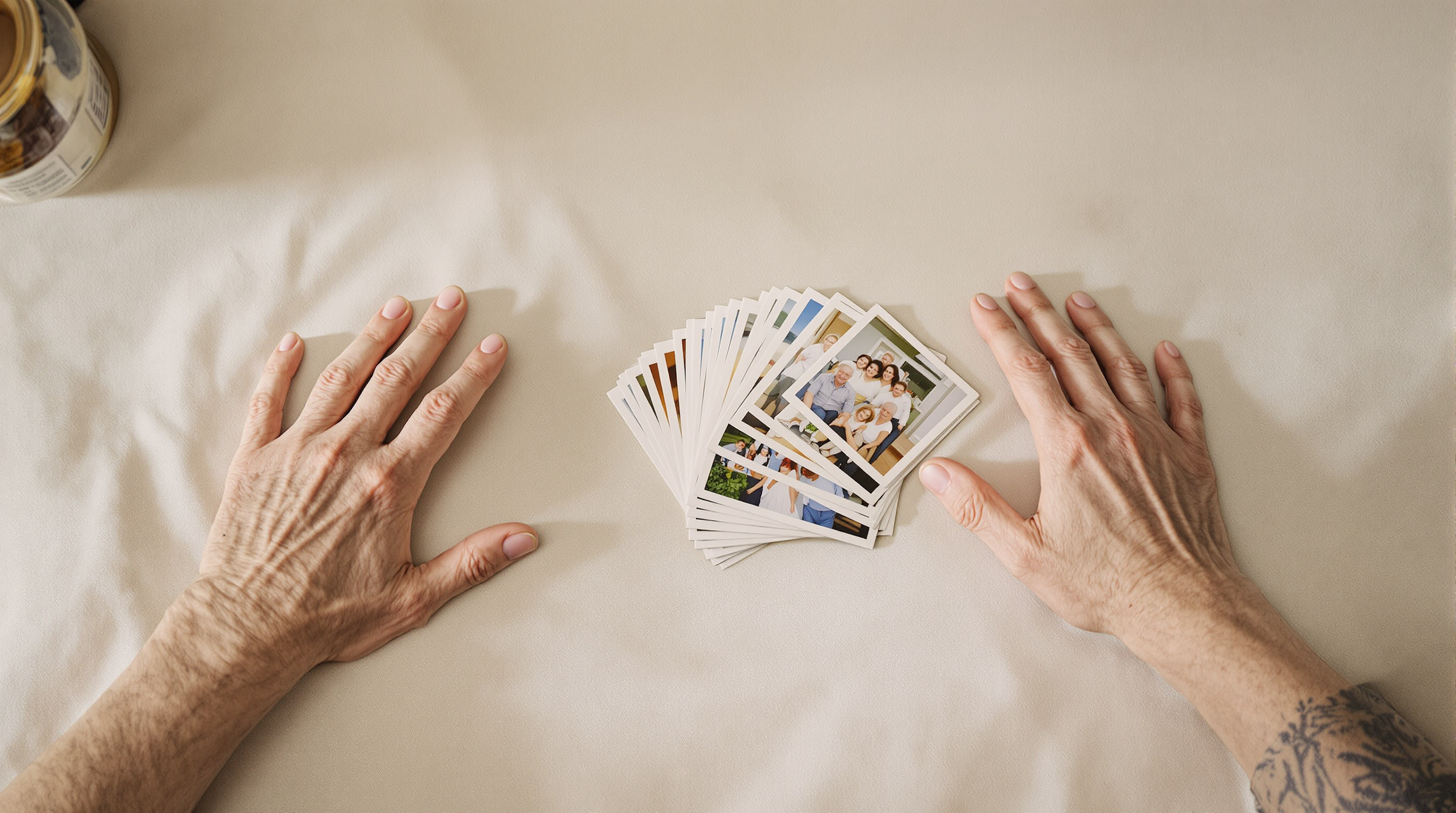
This is the single most common failure and it is almost invisible while you are making the selection. The person assembling a capsule is nearly always the person who took the photographs, which means they appear in roughly none of them. You will spend an evening choosing forty pictures of everyone you love and end up sending a capsule with no evidence that you existed.
The recipient does not want your photography. They want you at the age you are now, in ordinary clothes, in a room they recognize. That is the photograph that will be looked at longest, and you probably have three of them.
- Include the ones you do not like of yourself. The unflattering picture where you are laughing or squinting is worth more than the good one, because it looks like a person rather than a portrait.
- Ask someone else for their photos of you. Your partner, your sibling, your friend. Other people's cameras are where you live.
- Hand the camera over before you seal. If you genuinely have nothing, spend one afternoon fixing that. It is not vanity, it is the whole message.
- Scale is not the answer. One good photograph of you does more work than thirty of the view from the window.
Photograph the People Who Will Also Be Missing
If you are aware you may not be present at the opening, the same arithmetic applies to everyone older than you. The great aunt, the neighbor who has been there since before the child was born, the friend who is ill. In a fifteen or twenty year gap, several of the people in your capsule will be reachable only through it.
This is the one part of the job with a deadline attached. Curation can be redone at any point. A photograph of someone who is here now cannot be taken later. If there is one practical thing to do this month rather than eventually, it is taking those pictures while they can still be taken, and gathering the originals from relatives before the accounts holding them go quiet. The account side of that problem is its own subject, covered in the digital photo legacy guide.
Four Photographs That Reliably Do Not Survive
Every capsule that disappoints contains some of these, and they are easy to spot once you know the shape.
- The in-joke. Funny only with the setup, and you are the setup. Without it the picture reads as a random photograph of a sandwich.
- The technically good one. Sharp, well composed, nobody in it you care about. You are including it because you are proud of it. That is a different project.
- The photograph of a thing. The car, the meal, the finished extension. Objects need an owner in the frame to mean anything, and the object itself will look dated rather than significant.
- The screenshot. Messages, receipts, anything whose content is words on a screen. It will be unreadable in context and, in a set of photographs, it reads as filler.
One more thing worth checking before you commit: whatever you can attach in the way of words varies by tool, so find out what yours actually supports rather than assuming a caption will be there to rescue a photo. The safer plan is to choose photographs that would survive arriving with nothing at all.
What the Delivery Side Does and Does Not Fix
Good editing does not survive bad delivery, and the reverse is also true. The mechanics are short: you upload the photos, pick a delivery date, and seal it. On the date the recipient gets a link that opens in a browser with no account and no app, which matters here more than anywhere, because the person opening it may be a child who has never heard of the service you chose and has nobody left to ask about it.
The parts worth knowing before you start, rather than after: photos are stored as uploaded and are not recompressed, capsules are retained for 50 years by default, and a sealed capsule can be revoked any time before delivery but not after. Sending is also rate limited by plan, which is a real constraint if you were imagining one capsule per grandchild in an afternoon: one capsule ever without an account, one every 30 days on Free, one a week on Plus, one a day on Pro. The wider question of what actually delivers on a future date and which side needs an account are both worth reading before you seal anything long.
None of that makes an unexplainable photograph explainable. The delivery is the easy half.
Frequently Asked Questions
How do I choose photos for someone I will not be there to explain them to?
Say out loud the sentence you would tell them about each photo, then check whether any of that sentence is visible in the frame. If the meaning lives only in the words, the photo is a prompt for a story rather than the story itself, and it will not survive the gap.
Why do landscapes and holiday photos age so badly in a capsule?
A view means something because you were standing in it, and that is not in the file. Faces stay legible to someone who was not there, and rooms date a person because interiors change completely within a decade.
Should I include photos of myself?
Yes, and it is the thing most senders get wrong, because the person assembling a capsule is usually the one holding the camera. Ask other people for their photographs of you, and include the unflattering ones where you look like a person rather than a portrait.
Can the person receiving it write back and ask what a photo means?
Not by default. Replies are off unless changed, so treat a capsule as a one way delivery and choose photographs that need no follow up question to work.
What if I change my mind about what I put in?
A sealed capsule can be revoked at any point before the delivery date, so the selection is not final until it lands. After delivery it cannot be recalled, which is the same as any email.